Weekly · Daily New
Who is Christopher Luxon? published at 06:17 GMT Image source, Getty Images The incumbent in this election, centre-right National Party member Christopher Luxon has served as Prime Minister of New Zealand since 2023. Luxon, who became an MP during the 2020 election, was elected Leader of the National Party in November 2021, and in October 2023, after just three years in parliament, defeated Labour Party leader Chris Hipkins to become New Zealand’s 42nd prime minister. The 56-year-old also serves as Minister for National Security and Intelligence and Minister Responsible for Ministerial Services.
Before his career in politics, Luxon was CEO of Air New Zealand, the country’s national carrier - a position he held for six years from 2013 to 2019. He has a Master of Commerce in Business Administration from the University of Canterbury and is married with two adult children. When will we find out the results? published at 06:09 GMT Polling places opened at 09:00 local time and closed at 19:00 (Friday 20:00 GMT to Saturday 06:00 GMT).
Now that the polls have closed, preliminary results will be released progressively on New Zealand's official election results website - though these results are not final. After counting and verification, the official results will be declared by the Electoral Commission on 27 November. If there are clear winners tonight, that would be an early indication of which parties may form a government.
But a tight race could delay negotiations if no party wins an outright majority. And based on pre-election polls, there’s been no clear frontrunner in this race. Polls have now closed with early results expected soon published at 06:00 GMT The clock has just struck 19:00 in New Zealand and polls have now officially closed in what's been a tightly contested election campaign.
Now, the count begins and we'll be bringing you the latest updates. First, we'll start getting preliminary results. These are the counts of "advance votes" - ballots made before election day - which electoral staff started tallying at 09:00 today.
By 22:00 local time, preliminary results from 50% of polling booths are expected to have been released, and by 23:30, we should have 95% of these early results. Meanwhile, the tally of "ordinary votes" - all the ballots cast between 09:00 and 19:00 today - will also start the moment the polls close. All votes are counted by hand in New Zealand as the country does not use vote counting machines.
What is the 'overhang'? published at 05:52 GMT Image source, Getty Images The overhang is created when, for example, a party wins four electorate seats, but its proportion of the party vote would only win it two. The two extra seats are the “overhang” and the size of New Zealand’s 120-seat parliament expands by two to fit them in and not disadvantage the other parties. The last election in 2023 produced the country’s largest ever parliament of 123 MPs.
Te Pāti Māori or the Māori Party, won six electorate seats but only three percent of the party vote which only entitled it to four seats proportionally and created an “overhang” situation; two extra seats were added to parliament to accommodate the extra Māori Party MPs. Another overhang seat was created when a candidate died before the election and, due to the rules around the deaths of candidates, a special by-election was held at a later date. The overhang rules mean coalition negotiations can be affected: Where a government would need 61 seats to gain a majority in a 120-seat parliament, it would need more in a parliament of 122 or more.
Nearly two thirds of NZ expats are living Down Under published at 05:41 GMT Simon Atkinson Australia Producer As we wait for the polls to close and results to come in - some interesting stats on overseas voters. New Zealanders living abroad are able to vote if they're over 18 and have visited New Zealand in the last three years - there are a few other caveats but that's the general picture. According to the country's electoral commission, about 126,000 enrolled voters say they are based abroad this election, compared with 92,600 in 2023.
Perhaps unsurprisingly - because New Zealanders have the right to live and work here, pay tends to be higher and because it is geographically so close - 64% of those enrolled overseas are in Australia. Rounding out the top five are the UK, the US, Canada, and Germany. What is the Beehive? published at 05:32 GMT Image source, Getty Images The UK has Westminster.
The US has the White House. New Zealand has the Beehive. Known in Māori as Te Whare Mīere, the Beehive is the common name for the New Zealand parliament’s executive wing, where the offices of government ministers are housed in the nation’s capital of Wellington.
Its “9th floor" contains the office of the prime minister, while Cabinet meets on the top floor. The name comes from the building’s shape, which echoes that of a traditional, dome-shaped beehive known as a “skep”. Like Westminster and the Whitehouse, the Beehive is also often used as a metonym for New Zealand’s leadership.
Less than an hour to go before polls close published at 05:20 GMT It's just gone 18:20 local time in New Zealand and voters have less than an hour to go before polling booths close. The official voting period started 12 days ago on 26 October, with voters able to cast their ballots in person or if they're overseas, they can download their papers, vote and upload them. The count for early votes has already started and once voting locations close at 19:00, electoral staff will start counting today's ballots under the presence of scrutineers.
Once the count at a voting place is complete, results are phoned through to electorate headquarters for inclusion in the preliminary results. Why does New Zealand have such strict rules on election reporting? published at 05:11 GMT Let's bring you some more comments from Andrew Geddis, a professor and expert on election law at the University of Otago. Geddis tells us the strict rules on election coverage are aimed at maintaining calm on polling day and date back to the 19th century when "elections were these grand celebrations where people used to get absolutely ripping drunk and go out and vote in big hordes." "The upper middle class were horrified that the working class were acting in this way so they bought in laws to basically try to tame them," he says.
What's the weather across NZ on election day? published at 05:03 GMT While our reporter on the ground in Wellington enjoys a touch of sunshine ( see earlier post ), let's have a look at how the day's been for voters across the country. In the north, parts of Auckland have been hit by severe thunderstorms, bringing torrential rain, large hailstones and spectacular lightning. A little over an hour ago, the country's MetService said the storms were around Warkworth, Wellsford, Kaipara Flats and Ahuroroa, and they are now moving towards the southeast.
A severe thunderstorm watch remains in force for Auckland, Coromandel Peninsula, Waikato and Bay of Plenty. In the south, there's fine spells with scattered rain in Christchurch, heavy showers in Dunedin and cloudy periods with the odd shower in Queenstown. Image source, Getty Images Image caption, Lightning strikes in Auckland delayed the A-League derby between Auckland FC and the Wellington Phoenix at Go Media Stadium What is the Māori roll? published at 04:48 GMT New Zealand’s Māori can choose to vote on the general roll or the Māori roll.
They still have two votes - one for the party and one for the electorate - but if they choose to switch to the Māori roll they will vote in one of seven Māori electorates rather than one of the 64 general electorates. As New Zealand’s electoral commission explains, if a person lives in Rotorua and chooses the Māori roll they vote in the Waiariki electorate. If they choose the general roll, they vote in the Rotorua electorate.
Image source, Getty Images Image caption, Māori perform a haka at last year's Waitangi Day celebration Who can vote? published at 04:35 GMT Image source, Getty Images Only those who are 18 or older are eligible to enrol and vote in the election. Voters must also be a New Zealand citizen or resident for electoral purposes, and must have lived in the country continuously for 12 months or more at some point in their life. Those who are lawfully living in New Zealand and not required to leave within a specified time are considered residents for electoral purposes.
Meet the 72-year-old who cycled more than 300km to vote published at 04:22 GMT Image source, Doug Habgood As millions of New Zealanders exercise their democratic rights today, one keen cyclist has also done so - literally. Doug Habgood, 72, is currently on a weeks-long cycle tour of Australia and was in the rural town of Narrandera when he tried to vote online but found the system "clunky". So the semi-retiree from Nelson decided to vote in person.
But that meant a gruelling 330km bike ride to the closest polling booth in the nation’s capital of Canberra. "It was demanding," he tells the BBC of the eight-day trip that saw him ration his supplies of chocolate bars and oranges, battle pesky bushflies and tackle steep ranges. When he finally made it to New Zealand’s High Commission to vote on Tuesday, it was a "tremendously good feeling" which he hopes will inspire others.
"I’ve done my civic duty and if you think it's too complicated or too much bother to vote, then my example might help you." How does New Zealand’s voting system work? published at 04:14 GMT New Zealand doesn't have the most straightforward voting system. It uses “mixed member proportional” or MMP, under which each voter gets two votes - a party vote and an electorate vote. With their electorate vote, New Zealanders choose a particular candidate in their electorate; whoever wins the most votes wins and becomes the MP for that area.
With the party vote, New Zealanders help decide how many MPs each party gets in parliament - the more votes, the more seats - proportionally. MPs are taken from lists provided by the parties. Parties must win at least 5% of the party vote or win an electorate seat to get into parliament.
That might not sound too complicated - but we haven’t talked about the “overhang” yet. Or the Maori roll, both of which we'll get into in our later posts. A peaceful day in the New Zealand capital published at 03:59 GMT Tiffanie Turnbull Reporting from Wellington Hello from Wellington where the weather has been typically grey and blustery but the sun is beginning to peek out.
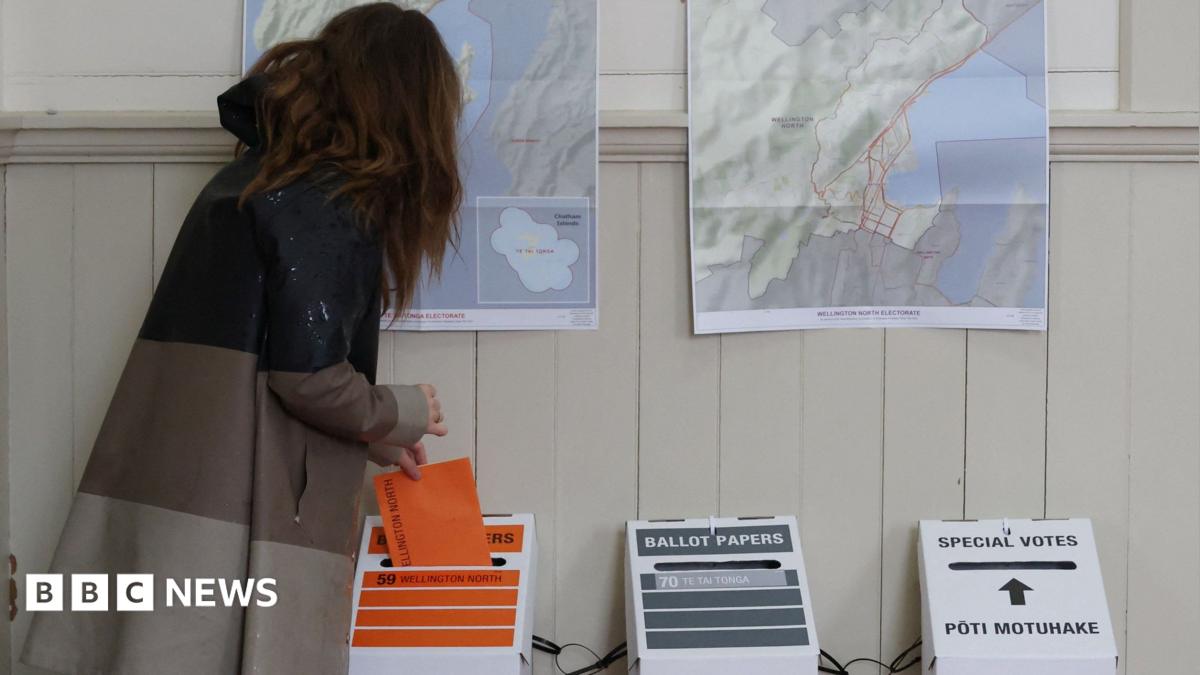
It’s a quiet day here - unless you knew better you wouldn’t guess it’s election day! Laws here mean voters are largely left in peace as they visit the ballot box - no last minute campaigning, no signs begging for votes, and no media scrums jostling for their two cents as they leave. But when polls close in about two hours, there’ll be a flurry of activity.
Stay with us and we bring you updates throughout the evening! Why can't we say anything about candidates? published at 03:48 GMT New Zealand has strict regulations around what can be reported on election day - there's a ban on anything that could be considered campaigning or advertising for a party. The rules are "really a throwback to the Victorian era," says Andrew Geddis, a professor and expert on election law at the University of Otago, and mirror the UK's election laws.
"There was an effort to really control how people behaved on election day, trying to remove any form of pageantry or excitement on the day and essentially try to turn it into an experience like going to church." The idea was that people arrived at the polling station "with a sober mind to deliberate on who to vote for with no sort of external pressure on you to try to influence you". Election day: What you can and can't do published at 03:27 GMT Image source, Getty Images New Zealand has some of the strictest election day rules in the world. From midnight until voting closes at 7pm, campaigning of any kind is banned - including any posts on social media.
You're also not allowed to display any campaign signs or show anyone how you voted. Even offering food or drinks within 100m of a voting place entrance is banned. What you are allowed to do is to tell people you've voted, or encourage people to vote in general.
You're also allowed to represent the party you support in a small way - like wearing a party lapel badge or rosette, though these must not have any candidate's name on them. Welcome to our live coverage published at 03:12 GMT Image source, Getty Images Hello and welcome to our live coverage of the 2026 New Zealand general election. Voting began today at 09:00 local time (20:00GMT) and booths will close at 19:00 local time.
However, polls have actually been already open for two weeks and local media estimate that a quarter of eligible voters have already cast their ballot. Nearly 3.8 million people have registered to vote. We will be bringing you live updates through polling to results - stay with us.
Source: BBC